


The integration of augmented reality (AR) into healthcare is transforming the industry at an unprecedented pace. From enhancing surgical precision to revolutionizing medical education, AR technologies are opening new frontiers for providers, patients, and researchers alike. As the global market for AR in healthcare continues its rapid growth trajectory, understanding the key trends, regional dynamics, and technological advancements becomes essential for stakeholders aiming to leverage this innovative tool effectively. This extensive industry report provides a comprehensive overview of market size, growth drivers, challenges, and opportunities projected through 2033, supported by in-depth analysis and authoritative data.
AR in Healthcare Market Overview
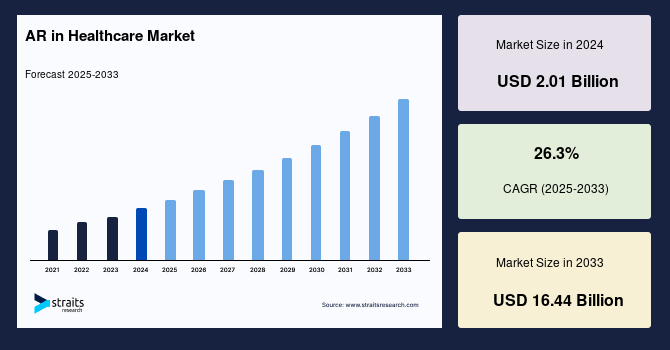
The worldwide AR healthcare market experienced a valuation of approximately USD 2.01 billion in 2024, reflecting strong momentum driven by technological advancements and rising adoption across medical disciplines. Forecasts indicate that the market will expand significantly, reaching an estimated USD 16.44 billion by 2033, with a robust compound annual growth rate (CAGR) of 26.3% during 2025–2033. This surge is primarily fueled by the increasing deployment of AR in various clinical applications and the proliferation of innovative startups entering the space. The sector’s growth underscores the growing recognition of AR’s potential to enhance diagnostic accuracy, improve patient outcomes, and streamline medical procedures.
Key Market Trends & Insights
- North America retained its dominant position with a 38% market share in 2024, owing to its advanced healthcare infrastructure, substantial R&D investments, and early adoption of AR solutions.
- The AR displays segment leads the technology landscape, expected to grow at a CAGR of approximately 25.4%, driven by continuous innovations in display hardware and software.
- Hardware components, notably head-mounted devices (HMDs) such as smart glasses and AR headsets, accounted for about 65% of the market in 2024, reflecting their critical role in immersive medical applications.
- The adoption of head-mounted devices (HMDs) remains prominent, offering immersive, hands-free experiences essential for surgical procedures, diagnostics, and remote consultations.
Market Size and Future Projections
- 2024 Market Size: USD 2.01 billion
- 2033 Forecasted Market Size: USD 16.44 billion
- Growth Rate: 26.3%
- Leading Region: North America
- Fastest-Growing Region: Europe
AR technology enhances healthcare professionals’ ability to diagnose, treat, and monitor patients more effectively. Surgeons can overlay real-time data during procedures, improving precision and reducing risks associated with minimally invasive surgeries. Additionally, AR plays a pivotal role in medical training by enabling immersive visualization of complex anatomical structures—an approach that significantly enhances learning retention and skill acquisition. For example, immersive AR applications facilitate interactive anatomy lessons, improving comprehension in medical education.
In patient care, AR supports real-time procedural guidance. Surgeons utilizing AR headsets or smart glasses can visualize internal anatomy over a patient’s body, leading to more accurate navigation and better outcomes. This technological integration is also crucial in post-operative care, enabling detailed monitoring and personalized treatment plans.
To explore comprehensive insights, healthcare providers can access detailed reports and case studies, including understanding insurance coverage for breast reduction surgery in los angeles, which highlights how insurance policies integrate with emerging medical technologies.
Growth Drivers for the AR Healthcare Market
Expansion of Medical Applications
AR’s versatile capabilities are significantly impacting diverse medical fields. It facilitates remote consultations, enabling physicians to diagnose and advise patients without physical visits, thereby expanding access to quality care. AR-driven surgical simulators provide a safe environment for training, reducing the learning curve for complex procedures. Furthermore, AR enhances real-time imaging and vessel mapping, critical for minimally invasive surgeries and intervention planning.
The technology’s potential extends to accelerating drug discovery processes. Researchers utilize virtual and augmented reality platforms to visualize molecular interactions, expediting the development of novel pharmaceuticals. This approach not only shortens R&D timelines but also reduces costs, fostering a more efficient pipeline for bringing new therapies to market.
Surge in AR Startups and Investment
The burgeoning landscape of AR-focused startups underscores the sector’s growth potential. Companies such as Subvrsive, VironIT, and Groove Jones are pioneering solutions for medical training, surgical planning, and patient engagement. These startups leverage AR to develop platforms that enable immersive diagnostics, remote collaboration, and data visualization—fundamental for advancing personalized medicine.
Public and private sector investments further accelerate this momentum. Governments recognize AR’s transformative capacity in healthcare; for instance, supportive initiatives aim to foster innovation through funding, policy frameworks, and R&D grants. Such collaborations are vital for integrating AR seamlessly into existing clinical workflows and ensuring scalable deployment.
Interesting:
- The future of healthcare growth and innovation in augmented and virtual reality technologies
- The future of healthcare growth and innovation in augmented and virtual reality technologies by 2030
- Understanding patient demographics and their critical role in healthcare 2
- Understanding healthcare service lines and their role in modern medical systems
Challenges Restraining Market Growth
Concerns Over Data Privacy and Security
Despite its advantages, AR adoption raises significant concerns regarding patient data privacy and cybersecurity. Sensitive medical information processed by AR devices—such as imaging data and personal health records—must be protected against hacking and unauthorized access. Risks include breaches of confidential patient details and potential misuse of visual and audio data captured during AR-assisted procedures. These issues pose regulatory and ethical challenges that could slow market expansion unless addressed with robust cybersecurity measures.
For organizations seeking to understand the evolving landscape of healthcare data protection, resources like the importance of healthcare data security provide valuable insights into safeguarding patient information amid technological innovation.
Market Opportunities and Future Outlook
Government Initiatives and Policy Support
Government backing remains a pivotal factor in advancing AR integration into healthcare systems. Countries such as the UK and Japan actively promote AR research through grants, regulations, and innovation hubs. These initiatives facilitate the development of advanced AR platforms tailored for medical use, from surgical navigation to telemedicine. Policy frameworks that support interoperability, data security, and clinical validation are critical for widespread adoption.
Moreover, increased government funding encourages startups and established firms to innovate, creating a fertile environment for technological breakthroughs. As a result, AR solutions are expected to become more accessible, affordable, and effective in addressing healthcare challenges globally.
Regional Dynamics and Market Penetration
- North America: Continues to lead the market with extensive technological infrastructure, early adoption, and a supportive regulatory environment.
- Europe: Projects a CAGR of approximately 26.8%, driven by increased healthcare expenditure, technological investments like 5G, and government-supported initiatives.
- Asia-Pacific: Exhibits rapid growth owing to the presence of major players like Sony and Microsoft, alongside increasing acceptance of AR across various sectors.
- LAMEA: Although currently experiencing slower growth due to infrastructural challenges, supportive policies and funding could foster future expansion.
Segmentation and Application Areas
By Technology
- Head Mounted Devices (HMDs)
- Handheld Devices
By End-User
- Hospitals and Clinics
- Diagnostic Laboratories
- Research Organizations and Pharmaceutical Companies
- Government and Defense Agencies
By Components
- Hardware
- Software
- Services
By Application
- Robotic-Assisted Surgery (RAS) systems
- Wound Care Management
- Physical Therapy and Rehabilitation
- Other innovative healthcare solutions
By Region
- North America
- Europe
- Asia-Pacific
- Middle East and Africa
- Latin America
Leading Industry Players
Major companies shaping the AR healthcare landscape include Google, Microsoft Corporation, Sony, Siemens, Philips, AccuVein, EchoPixel, and HTC. Their continuous innovations and strategic alliances are driving market growth and expanding the scope of AR applications in medicine.
Recent Developments
- July 2025: Launch of new digital PCR platforms by biotech firms enhances molecular diagnostics.
- June 2025: Microsoft introduced the latest HoloLens 2, optimized for surgical planning and training.
- May 2025: Google unveiled Android XR, aiming to unify XR experiences across devices and platforms.
- April 2025: HTC introduced the Vive XR Elite, a mixed reality headset specifically designed for medical training and patient education.
For a detailed understanding of market dynamics, including regional insights and growth forecasts, healthcare stakeholders can explore navigating insurance coverage for breast reduction surgery to understand how insurance frameworks intersect with emerging medical technologies.
Conclusion
AR’s transformative impact on healthcare is undeniable, with ongoing innovations promising to reshape clinical practices, education, and patient engagement. As technological advancements continue and supportive policies evolve, the market is poised for sustained growth. Embracing these changes requires strategic planning, robust data security measures, and continued investment in research and development. The future of AR in healthcare holds immense potential for improving outcomes, reducing costs, and making medical expertise accessible worldwide.
—
For further insights and tailored consultations, contact our expert team or download the full report.